
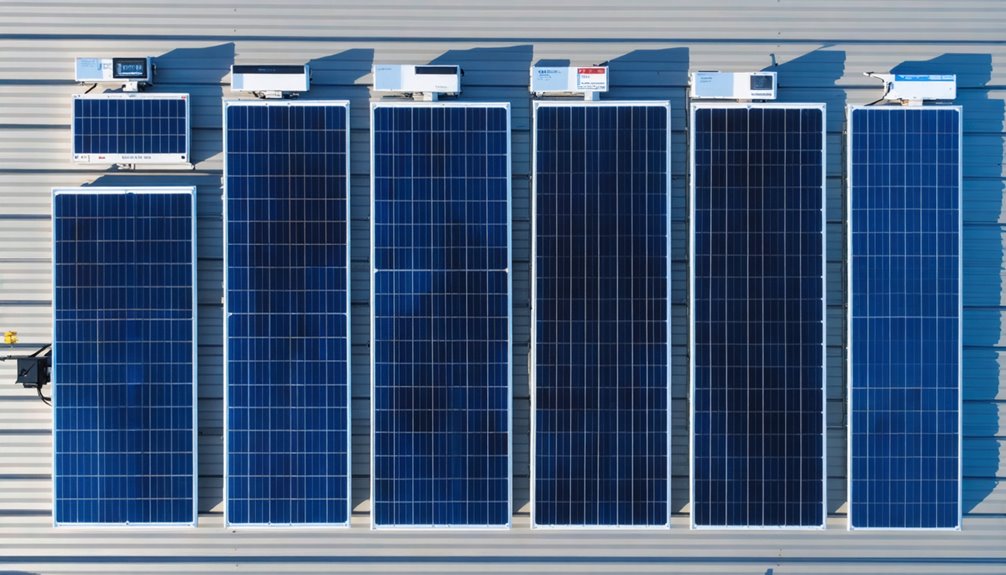
You seek the top solar panel efficiencies for 2025, where Maxeon tops the list at 24%, but JA Solar and REC Group follow closely. You’ll compare monocrystalline against polycrystalline rates, or explore N-type versus P-type cells. As technologies like TOPCON and heterojunction advance, real-world performance varies wildly from lab tests. Yet, which brands truly excel in high-power metrics?
Key Takeaways
- Monocrystalline panels achieve 18-24% efficiency, surpassing polycrystalline’s 15-18% for space-limited installations.
- N-type cells exceed 24% efficiency with lower degradation, outperforming P-type’s below 20%.
- HJT technology offers over 24% efficiency and better shade performance than TOPCon’s 23-24%.
- Back-contact cells reach above 24% efficiency by reducing shading, better than traditional PV’s 15-20%.
- Maxeon panels lead at 24% efficiency, followed by JA Solar at 23% and REC at 22.6%.
Monocrystalline Vs Polycrystalline Efficiency Rates
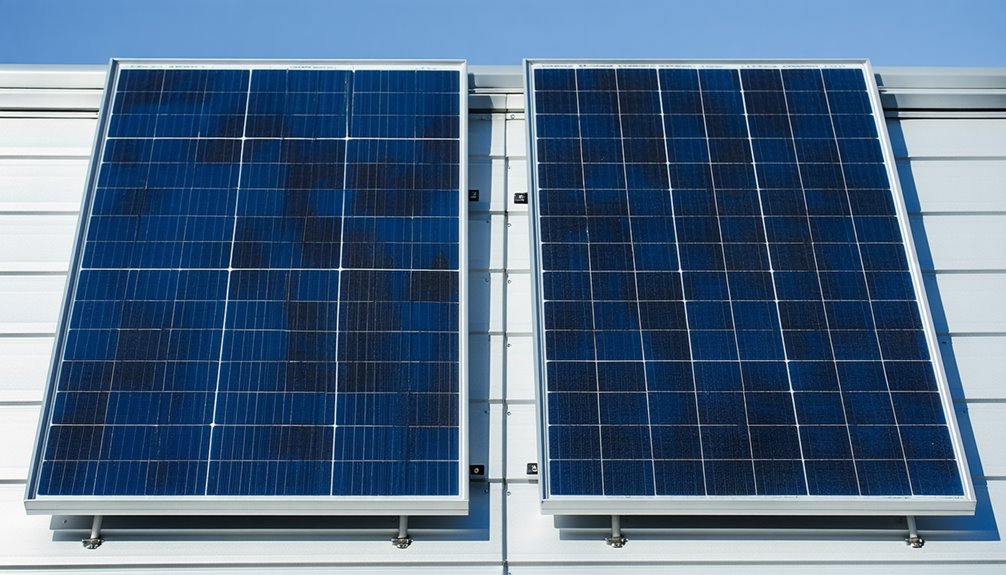
When you compare monocrystalline and polycrystalline solar panels, you’ll find monocrystalline options lead with efficiency rates of 18% to 24%, making them the top choice for maximum energy output.
You get this edge from their single-crystal silicon structure, which boosts sunlight absorption and electricity conversion. As a savvy buyer, you’ll notice a reliable solar panel supplier often recommends monocrystalline for space-constrained setups where you need every watt.
In contrast, you see polycrystalline panels deliver lower efficiencies, typically 15% to 18%, due to their multi-crystal silicon makeup that increases internal resistance and cuts light absorption.
Yet, if you’ve got plenty of roof space, you’ll appreciate how these panels offer a budget-friendly alternative, balancing cost with decent energy generation without breaking the bank.
To maximize your investment in high-efficiency panels, consider choosing the best Tier-1 Solar Panels for superior quality and performance in home installations.
N-Type Vs P-Type Solar Cell Efficiencies
As you explore N-type versus P-type solar cell efficiencies, you’ll discover N-type cells often achieve over 24% efficiency thanks to advanced tech like TOPCon and HJT, surpassing the 20% cap of traditional P-type cells.
You benefit from N-type’s lower light-induced degradation, which guarantees better long-term performance and efficiency retention throughout the panel’s lifespan.
You’ll notice N-type cells boast a superior fill factor, boosting their overall energy conversion rates compared to P-type options.
Manufacturers increasingly adopt N-type technology, including TOPCon and HJT variants, as you seek more efficient solar solutions.
While P-type cells cost less to produce, they suffer greater losses from electrical impurities, prompting a shift away from them.
You gain enhanced performance with N-type, reflecting the industry’s push for superior efficiency.
TOPCON Vs Heterojunction Technology Comparisons
You compare TOPCon’s efficiency of 24-25% in commercial panels, which minimizes recombination losses, against heterojunction’s 24-26% that excels even in shaded or high-temperature conditions.
You evaluate the cost differences, noting that heterojunction’s complex manufacturing drives up production expenses compared to TOPCon’s more straightforward approach, impacting market prices.
You assess performance benefits like heterojunction’s superior longevity and low degradation, which often make it preferable for warmer climates despite TOPCon’s solid structural improvements.
Efficiency Comparison
While TOPCon technology enhances solar cell efficiency through superior light absorption and minimal electrical losses, delivering 23% to 24% in commercial panels, Heterojunction (HJT) combines crystalline and amorphous silicon layers to exceed 24% with better temperature coefficients.
You’ll notice TOPCon excels in standard conditions, where it minimizes losses for reliable output. However, if you’re dealing with high temperatures or low light, HJT’s hybrid structure shines, maintaining higher performance. You choose based on your environment—TOPCon for consistent efficiency, HJT for superior adaptability.
| Efficiency Aspect | Comparison Details |
|---|---|
| Standard Efficiency | TOPCon: 23-24%; HJT: >24% |
| Temperature Performance | TOPCon: Good; HJT: Better coefficients |
| Low-Light Conditions | TOPCon: Solid; HJT: Superior output |
You weigh these factors to optimize your solar setup.
Cost Differences
TOPCon solar panels cost less to produce than heterojunction (HJT) panels because they rely on simpler manufacturing and fewer materials.
You’ll find that this keeps your initial costs down if you’re choosing TOPCon for your solar setup. In contrast, HJT panels demand more complex processes, driving up production expenses and making their upfront installation costs considerably higher.
You should consider how this affects your return on investment.
TOPCon technology boosts cell efficiency without inflating prices much, so it’s ideal if you’re budget-conscious yet seeking solid performance. HJT’s premium efficiency—up to 26% versus TOPCon’s 24.7%—complicates ROI calculations, as you pay more initially for that edge.
Ultimately, you balance short-term savings with long-term value when deciding between them.
Performance Benefits
Beyond costs and ROI, performance advantages shape the real-world value of TOPCon and heterojunction (HJT) solar panels.
You’ll find TOPCon achieves efficiencies over 24% through its tunnel oxide layer, which enhances electron flow and cuts recombination losses. In contrast, HJT combines amorphous and crystalline silicon for around 25% efficiency, minimizing thermal losses and excelling in low-light conditions.
You benefit from TOPCon’s higher temperature coefficients in hot climates, while HJT maintains efficiency across wide temperature ranges, making it versatile for varied environments.
As manufacturing shifts to N-type tech like these, you’ll see lower degradation rates and greater longevity than P-type options.
Real-world tests show HJT yields more energy amid shading and temperature swings, whereas TOPCon shines with superior efficiency and scalable production.
Back-Contact Vs Traditional PV Cell Performance
You notice that back-contact solar cells often achieve efficiencies above 24% by eliminating front-side shading, surpassing traditional PV cells’ typical 15-20% range.
You’ll see how these cells minimize shading impact with rear-side contacts, boosting performance in partial shade unlike front-contact designs that suffer more losses.
You appreciate the design benefits, including higher fill factors and long-term energy yields, which make back-contact options worthwhile despite higher initial costs.
Efficiency Differences
When comparing back-contact (IBC) solar cells to traditional PV cells, you’ll spot key efficiency differences driven by design.
You place conductors on the rear in IBC cells, freeing up the front for maximum sunlight absorption, which boosts efficiency ratings often above 22%.
In contrast, traditional PV cells feature metallic contacts on the front that obstruct light, typically limiting efficiency to around 18% for standard polycrystalline types.
You’ll appreciate how IBC’s design creates a larger active area, enhancing overall performance.
Manufacturers push IBC advancements, achieving gains toward 25% in new models, while traditional designs see slower improvements.
Though IBC cells cost more to produce, their superior efficiency and long-term energy yield offset expenses, making them ideal for savvy solar investments.
Shading Impact
Shading affects solar panel performance, with back-contact (IBC) cells outperforming traditional PV cells thanks to their rear-mounted contacts.
You’ll notice that IBC cells minimize shading losses by placing electrical contacts on the back, which creates a larger active area on the front. This setup enhances your panel’s performance in partially shaded conditions, where you might deal with obstacles like trees or buildings.
Traditional PV cells, however, feature front contacts that cast shadows, reducing efficiency and output in those same scenarios.
You’re getting higher overall efficiencies with IBC cells—often above 24%—compared to traditional ones that range from 15% to 21%.
In shaded environments, you’ll maintain better energy production because IBC designs cut down on losses. Studies confirm you can boost energy yield by up to 10% in frequently shaded areas using back-contact technology over conventional panels.
Design Benefits
While traditional PV cells rely on front-side contacts that block sunlight and limit efficiency to 15-20%, back-contact designs move all contacts to the rear, boosting performance above 23% with minimal obstructions.
You’ll notice back-contact cells, like IBC designs, minimize shading and enhance efficiency by placing all electrical contacts on the rear side. This setup improves light absorption, so you get higher performance compared to traditional cells’ front-side contacts that reduce it.
You benefit from a higher fill factor in back-contact cells, as they improve electron capture and cut resistive losses for maximum conversion efficiency.
You’ll also appreciate their better temperature coefficients; they perform stronger in high-heat conditions, yielding more energy in warm climates.
Advancing production lets you install thinner, lighter back-contact designs without losing efficiency, offering flexibility and top performance.
High-Power Vs Standard Panel Efficiency Metrics
High-power solar panels deliver superior efficiency metrics that outpace standard panels, as models like Jinko Solar’s Tiger NEO achieve up to 515W output with 23.8% efficiency, compared to standard panels’ typical 250W to 450W range and 15% to 20% ratings.
You’ll gain more from monocrystalline options like Maxeon’s 445W panels at 24.1% efficiency, surpassing standard polycrystalline ones that top out around 18%. Emerging N-type cells push high-power units to 24.3% efficiency, so you maximize energy yield in limited spaces.
Check this comparison table—you’ll see the clear advantages:
| Panel Type | Power Output (W) | Efficiency (%) |
|---|---|---|
| Jinko Tiger NEO (High) | 515 | 23.8 |
| Maxeon Mono (High) | 445 | 24.1 |
| N-type Emerging (High) | 500+ | 24.3 |
| Standard Poly | 350 | 18 |
The IEA reports on solar PV market trends highlight the growing deployment of these high-efficiency technologies worldwide.
Real-World Vs Lab-Tested Efficiency Outcomes
You see impressive efficiency numbers in lab tests for high-power panels, but real-world conditions often reduce those outcomes to 75-85% of the rated figures due to temperature fluctuations, shading, and installation variables.
You’ve got to understand that under Standard Test Conditions (STC), panels hit up to 24% efficiency at 25°C and 1000W/m² irradiance. But you won’t find those ideal setups consistently outside the lab, so output drops considerably from ambient factors.
Take monocrystalline panels: they boast 20-24% in labs, yet you’ll see them at 15-20% in daily use, thanks to dust and shading losses.
On the brighter side, you can opt for new N-type cell technologies. Studies show they maintain better performance, with only a 10-15% drop from lab figures, outperforming traditional silicon panels in real scenarios.
Brand-Specific Efficiency Rankings for 2025
As lab-tested efficiencies give way to real-world applications, brands in 2025 push boundaries with innovative designs.
You’ll discover Maxeon topping the rankings at 24% efficiency with its SPR-MAX7-475 model, delivering a robust 475 W output that maximizes energy harvest in diverse conditions.
You can’t overlook JA Solar, trailing closely at 23% efficiency via the JAM54D40-460/LB panel, which pumps out 460 W and excels in cost-effective setups.
Then, you’ll see REC Group hitting 22.6% with the REC Alpha Pure-RX 470, offering 470 W for reliable performance.
Don’t discount VSUN’s 22.52% efficiency in the VSUN450N-96BMHR-DG-BB, yielding 450 W, or Canadian Solar’s TOPHiKu6 BoB at 22.5% with 460 W, both providing strong value for your solar investments.
Conclusion
You’ve explored the top solar panel efficiencies, from Maxeon’s leading 24% to Canadian Solar’s 22.5%. You see how monocrystalline outshines polycrystalline, N-type beats P-type, and innovations like HJT and TOPCON boost performance. In real-world scenarios, high-power panels deliver superior yields over standard ones. For 2025, choose brands like Maxeon or REC for peak efficiency—you’ll maximize energy savings and sustainability in your solar setup.